Showing posts with label college. Show all posts

Thursday, 16 March 2017

If School was Equal for Everyone

       If school was equal for everyone...


  • The most struggling students would have the best teachers.  We know that good teachers make a difference in student outcomes.  Our best teachers are also our best motivators; they help students to see the value of effort and their students try hard and do their best every day.  Students who struggle academically need good teachers who believe that all students can learn and show this by their actions as well as by their words.  I hate to say it, but students who have a lot of support at home--students with parents that value education--typically do fine in school regardless of the quality of their teacher.  If there are only a relatively small portion of the teaching force that is in the "best" category, they should be teaching the most struggling students.
  • Students would be allowed to learn at their own pace.  They wouldn't have to "move on" because the rest of the class is learning faster than they are.  And they wouldn't have to sit in class being bored with nothing to do because they "get it" faster than everyone else.  Student engagement is increased when students have some control as to the pace of their learning.
  • Opportunities for all sorts of classes would be available to all students.  Music, art, physical education, higher-level (college-prep) classes would be available to everyone.  If a student struggles in math but wants to take Calculus at some point, there would be a path of courses (and professional educator assistance) to help her to get to Calculus.  If a student wanted to take two or three foreign languages prior to high school graduation, he could do that and still complete all of the other requirements.
  • There would be a lot less competition for grades and a lot more desire for learning.  "A" students would receive no more praise than "C" students because effort would be valued over performance.  Students who didn't "get it" the first time or the second time would be given multiple opportunities to reach proficiency.  Some will exceed expectations and some will barely meet the expectations.  But all will be rewarded for learning.
  • Students with career goals after high school will receive the same amount of help and guidance as students with college goals.  Preparation for civil participation will be part of every students' P-12 experience.  And students who don't know what they want to do after high school, will receive opportunities to understand their skills and to consider different options.
     We live in an imperfect world filled with imperfect people, imperfect teachers, imperfect students, and imperfect schools.  We can wish for perfection, but we can't realistically reach perfection.  The best we can do is recognize our needs, understand our problems, and work together to find the best solutions for our students.  Amazing things happen when we work together.  While (usually) quite un-amazing things happen when we refuse to change in the name of we've-always-done-it-this-way.

       Our schools work hard to produce the best outcomes for our students given the staff and money and facilities and materials and students and parents that we have.  When things don't work, the answer to fix it and make it work.  Everything can be better; it may take a lot of hard work, but it can be better.

       Our schools may not be equal for everyone, but they can be the most positive places for our students and teachers if we want them to be.

Tuesday, 27 December 2016

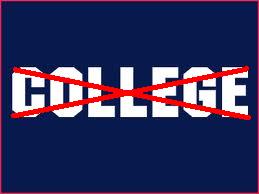
College Not For All

       I'm going to start by saying that I went to college, my wife went to college, my siblings went to college, I want my children to go to college, and everyone I work with went to college.  I'm a big fan of "going to college".  College provides specialized knowledge in a specific field of study; often by people who are experts in that field.  There is a benefit to going to college, but since this post is about "not going to college", I'll just say that the benefits of college are well documented.


       So why am I (a lifelong educator) writing about not going to college?  Because public school desire to teach ALL students.  All students are welcome in our public schools.  We take all students.  We don't have some sort of litmus test that permits some students to enter our public schools and denies others t enter; we take everyone.  And in doing so, we have an obligation to teach all students.  This means that we teach the students who are college-bound as well as those that are not.  This leads to the dilemma of all public schools: Are we preparing students for college?  Are we preparing them for the world of work?  Or, Are we doing both?  (And if the answer is the latter, then How do we do that?)

       We know that all students won't go to college.  (source)  We also know that some will go to college and won't finish college. (sourceHere is a slideshow of 25 jobs that don't require a college degree--although nearly all (or actually all) of these jobs require some sort of education and/or training beyond high school.  So the question remains, How do prepare the college-bound students and the non-college-bound students at the same time?

       The simple answer is that this is a complex problem.  It is a problem that (in my opinion) requires multiple options and pathways for high school students.  It is a problem that does not lend itself to one-size-fits-all solutions.

       It is fair to say that all public schools recognize this need to prepare students for their lives beyond high school--whatever they may be.  But it is also fair to say that some requirements are aimed (more) at the college-bound students than at the non-college-bound students.

       My solution views these two subgroups of students as much more alike then different in terms of the skills and knowledge that they need for both college and work.  Clearly, reading and basic mathematics understanding is needed.  By "reading", I include understanding the context of what is being read; and I include reading and understanding non-fiction and technical manuals.  Our civilized world requires reading.  Medical reports, insurance papers, legal documents such as wills and mortgages all require a level of reading in which people can read and understand.  By "basic mathematics", I include understanding and calculating things such as sales tax and interest income.  People should be able to gain information from a chart, graph, or table of numbers.  People need to know what a percent means and what fractions mean.  Calculators can do the calculations, but people need to do the "understanding".  Beyond reading and mathematics, I believe that a good understanding of other typical high school subjects is needed to help people gain an understanding of the world and the people around them.  These include science, history, art, some computer skills, health, and knowing a foreign language--which is extremely common outside of the United States.

       Beyond these academics, I believe that the rules and regulations that take place in a high school and in the classroom should instill in our students a sense of right and wrong as well as a sense of how to exist as an adult in society.  When my daughter was in kindergarten, her teacher told us that everything they do has a purpose.  What may look like "fun" or "downtime" to the non-kindergarten-teacher observer, has a purpose.  Similarly, everything in high school should have a purpose.  Whether you are going to college or work, you need to be on time, you need to be polite, you need to listen.  You need to learn from others and you need to be able to work with others.  You need to know that sometimes you'll get some help to do things and sometimes you have to do things on your own.  You need to be responsible and you need to take on responsibilities.

       It seems to me that when employers complain about young people in the workplace, it isn't so much that they lack reading and mathematics skills--although I hear this as well.  It is more that they lack the ability to accept responsibilities, to understand written and verbal directions, and to follow through on important tasks.  These skills are needed for the college students also.

       College isn't for everyone.  But public schools and their graduation requirements and daily rules and regulations are for everyone.  Learning is a lifelong skill.  It doesn't stop on graduation day.  We want all students to succeed regardless of the path they take after college.


Follow us

@Way2themes

Follow Me