Showing posts with label college and career. Show all posts

Friday, 3 February 2017

Learning and Thinking - (getting the right answer isn't good enough anymore)


       Learning and thinking have always been closely linked.  But sometimes, in our schools, we only achieve the appearance of learning--often accompanied by very little thinking.  This problem has been recognized by educators for a long time.  In recent years, however, we have been addressing this issue on various fronts.

       Let me begin by explaining what I mean by the term Appearance of Learning.  This is when students get good grades, but their actual learning is very low.  The grade to the students and to their parents makes it appear as if they have learned a lot, but the attainment of those grades may have been based partly on non-academic measures such as good behavior or mere compliance with rules such as turning in homework on time.  This is a problem because when students move on to more complicated coursework that requires previous knowledge, they struggle due to never actually learning the earlier content in the first place.

     Over the past few years, there has been a stronger attempt to balance the need for teaching skills (such as solving an equation) with the need for teaching conceptual understanding (such as using an equation to solve a problem).  This sort of "teaching" is different from when our students' parents were in school--a time in which just-getting-the-answer might have seemed good enough.  Today we know that this isn't good enough.  Students going to college and students going to work need skills and knowledge beyond merely doing what they are told to do.  Today's world demands more from our citizens.


       Our schools recognize this need and we are trying to make changes to address this challenge.  It's hard to change a system of 100,000 schools, 50,000,000 students, and 3,000,000 teachers.  But (indeed) this change is already happening.  What we used to call a "computer room" is now just about any classroom in the building.  Classrooms with students sitting in nice, neat, straight rows that discouraged collaboration among students have been replaced with classrooms with tables or desks arranged in groups to encourage students to work together and ask questions of each other and learn together.  Grades for non-academic behaviors (mentioned above) are strongly discouraged so that a student's grade can more accurately reflect his/her ability in the content.  Finally, student engagement strategies and growth mindset strategies are constantly being discussed and implemented.  These reflect our knowledge of the best way that students learn.  No longer do we expect everyone to learn strictly by listening to the teacher and taking notes.

       Indeed, the change to an educational system that requires more from our high school graduates is well underway.  The past is in the past and we're not going back.  Those that choose not to change risk creating a generation that is ill prepared for the challenges that they will face.  Learning, thinking, reasoning, and problem solving will be more and more integrated into our schools.

       You're welcome.


Tuesday, 27 December 2016

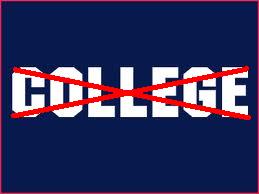
College Not For All

       I'm going to start by saying that I went to college, my wife went to college, my siblings went to college, I want my children to go to college, and everyone I work with went to college.  I'm a big fan of "going to college".  College provides specialized knowledge in a specific field of study; often by people who are experts in that field.  There is a benefit to going to college, but since this post is about "not going to college", I'll just say that the benefits of college are well documented.


       So why am I (a lifelong educator) writing about not going to college?  Because public school desire to teach ALL students.  All students are welcome in our public schools.  We take all students.  We don't have some sort of litmus test that permits some students to enter our public schools and denies others t enter; we take everyone.  And in doing so, we have an obligation to teach all students.  This means that we teach the students who are college-bound as well as those that are not.  This leads to the dilemma of all public schools: Are we preparing students for college?  Are we preparing them for the world of work?  Or, Are we doing both?  (And if the answer is the latter, then How do we do that?)

       We know that all students won't go to college.  (source)  We also know that some will go to college and won't finish college. (sourceHere is a slideshow of 25 jobs that don't require a college degree--although nearly all (or actually all) of these jobs require some sort of education and/or training beyond high school.  So the question remains, How do prepare the college-bound students and the non-college-bound students at the same time?

       The simple answer is that this is a complex problem.  It is a problem that (in my opinion) requires multiple options and pathways for high school students.  It is a problem that does not lend itself to one-size-fits-all solutions.

       It is fair to say that all public schools recognize this need to prepare students for their lives beyond high school--whatever they may be.  But it is also fair to say that some requirements are aimed (more) at the college-bound students than at the non-college-bound students.

       My solution views these two subgroups of students as much more alike then different in terms of the skills and knowledge that they need for both college and work.  Clearly, reading and basic mathematics understanding is needed.  By "reading", I include understanding the context of what is being read; and I include reading and understanding non-fiction and technical manuals.  Our civilized world requires reading.  Medical reports, insurance papers, legal documents such as wills and mortgages all require a level of reading in which people can read and understand.  By "basic mathematics", I include understanding and calculating things such as sales tax and interest income.  People should be able to gain information from a chart, graph, or table of numbers.  People need to know what a percent means and what fractions mean.  Calculators can do the calculations, but people need to do the "understanding".  Beyond reading and mathematics, I believe that a good understanding of other typical high school subjects is needed to help people gain an understanding of the world and the people around them.  These include science, history, art, some computer skills, health, and knowing a foreign language--which is extremely common outside of the United States.

       Beyond these academics, I believe that the rules and regulations that take place in a high school and in the classroom should instill in our students a sense of right and wrong as well as a sense of how to exist as an adult in society.  When my daughter was in kindergarten, her teacher told us that everything they do has a purpose.  What may look like "fun" or "downtime" to the non-kindergarten-teacher observer, has a purpose.  Similarly, everything in high school should have a purpose.  Whether you are going to college or work, you need to be on time, you need to be polite, you need to listen.  You need to learn from others and you need to be able to work with others.  You need to know that sometimes you'll get some help to do things and sometimes you have to do things on your own.  You need to be responsible and you need to take on responsibilities.

       It seems to me that when employers complain about young people in the workplace, it isn't so much that they lack reading and mathematics skills--although I hear this as well.  It is more that they lack the ability to accept responsibilities, to understand written and verbal directions, and to follow through on important tasks.  These skills are needed for the college students also.

       College isn't for everyone.  But public schools and their graduation requirements and daily rules and regulations are for everyone.  Learning is a lifelong skill.  It doesn't stop on graduation day.  We want all students to succeed regardless of the path they take after college.


Follow us

@Way2themes

Follow Me