Showing posts with label public schools. Show all posts

Thursday, 6 April 2017

Public Schools and Choice

       Is it true that public school kids and their public school parents don't have choices?  I'm sure that I will expose my ignorance of the "far right" and the "far left" and their respective discussion points about school choice; but isn't it the case that we already have a fair amount of choice when it comes to educating our students?

"Better Schools"

       I think I understand the issue of "better schools" in richer areas.  It goes like this:

  1. Richer people (even upper-middle-class and middle class people) are more likely to have college degrees.
  2. Parents with college degrees are more likely to value education.
  3. People who value education are more likely to instill these values into their children.
  4. Children with parents that value education (especially if their parents--themselves--are college graduates) are more likely to do well in school.
  5. Hence, schools in richer areas have students who do well in school.  (I'm defining "do well in school" to mean students get good grades and (hopefully) actually learn and understand the content of the courses that they take.) 

Since teachers (generally) make the same amount of money in these "better" schools as they do in schools with lower student achievement, teachers (generally) prefer to teach in these schools.  Teachers get to spend more time on teaching and less time on disciplining.  Additionally, these schools seek to hire good, highly-able teachers to meet the demands of their students.

"Low-achieving schools"

       I think I understand some of the issues of "low-achieving schools".

  1. Some kids are motivated to do well in school and some are not.  Low-achieving schools have a majority of low-motivated students.
  2. Low motivations comes from a variety of factors including: 
    1. Lack of parental encouragement and/or parental example.
    2. Lack of engaging teachers and interesting lessons.
    3. Lack of a sense of belonging to your school.
    4. Lots of other reasons.
  3. Low-achieving schools tend to have more discipline issues that come up.
  4. This leads to stricter school rules and (sometimes) stricter consequences.
Many teachers find it difficult to have an effect on a student's education in these type of schools.  Many teachers were never trained to handle multiple discipline issues and they themselves were never part of a high school class that didn't care about learning.  Hence, teachers who begin in these schools seek to move to "better" schools.  Hence, low-achieving schools have the additional issue of (on average) having a less experienced staff year after year.


Choice

       Usually when hear conversations about school choice. the issue is, "I don't like my child's public school and I want him/her to go somewhere else."  It may be more typical for parents with kids in the low-achieving school to want other choices, but I'm sure there are parents with kids in the better schools who also want this.  So here is my (perhaps limited) knowledge of the choices that people have:

  • Move.  Parents who are sufficiently unhappy with their child's public school and are quite happy with a nearby (or not so nearby) other public school can move into the district with other school.  I know that moving is a great inconvenience and it would take some mighty strong feelings for family to make this decision--but it is an option.  However, if the better school is in an area that you can't afford to live, then this isn't an option.
  • Charter schools.  This option is gaining in popularity.   Twenty years ago, less than one percent of American schools were charter schools.  Today that number is over 5%.  In 2009, 40 of the 50 states in the U.S. had charter schools.  Charter schools are public schools, so they are free just like public schools.
  • Homeschooling.  This option is also on the rise.  In 1999, 850,000 America students were home-schooled.  By 2011, that number rose to 1,770,000 of our nation's approximately 50 million students.  (source)  Homeschooling can occur at any level from kindergarten to grade 12.
  • Online learning.  I have to say that this an area that I am less familiar with.  I know middle and high school students can take online classes, but I don't know the rules about how they count toward graduation and whether you can completely skip public school and get all of your secondary education online.  Personally, this sounds like a very lonely learning experience.  But perhaps as a supplement it is a good choice for some.
       My feeling on this issue is the same as it is on most issues: Do what you think is best for your child.  If you want to leave public schools because you're angry about one thing in one course, I would suggest looking for options for that one course--but don't leave the whole school because of it.  If you have a broader complaint about your child's public school and want to consider other options, do your research.  But be careful because something else isn't always something better.


Sunday, 5 March 2017

How much Parental Involvement is 'Just Right'?

       Parents are an important part of the educational process.  But some parental involvement is too little and some is too much.  What is the "sweet spot" of parental involvement; What would you consider to be (as Goldilocks would say) "just right" when it comes to parental involvement?

       No one would dispute the value of a strong connection between the home and the school when it comes to better outcomes for education.  We (educators) want parents to be involved.  We want parents to celebrate with us the academic successes of their children, and we want parents to support and to assist us when struggles and obstacles occur along the way.  As teachers, what do you consider to the right amount of parental support?  Is it possible to have too much involvement from the home? What do you consider to be too little support?  As a parent, how do you approach your involvement in your child's education?  Do you leave it all to the schools and the teachers?  Do you check on homework and that's it?  Are you comfortable talking to your child's teacher?

       How much parental involvement falls into the "Just Right" category?  This question may have a different answer for elementary teachers than for high school teachers.  Parents with more education may feel different than parents with less education.  Parents of younger children may answer this question differently than parents of older children.

       As a high school teacher, whenever we had parent-teacher conferences, the parents of students with high grades often came and the parents of students with low grades usually didn't come.  I also saw many parents who (themselves) had a college education and few parents who never went to college.  As a school we would often discuss the issue of finding ways to involve parents and finding ways to invite parents to different school events.  Whenever I reached out to a parent (due to both positive and negative events that occurred with their child in my classroom), I always found a parent who was willing to help and who was appreciative of the contact.

       On the other hand, I've also experienced parents who wanted weekly updates (phone calls or emails); parents who would constantly contact me and other teachers about the smallest issues that occurred in the school relative to their child.  Sometimes these folks were very anti-public-school and they were anxious to share their alternate opinion about what was happening and what (instead) should be the job of the schools.  But most of the time these parents were supportive of the school and certainly supportive of their child--but I worried that the child (in high school) was not given the opportunity to make even the smallest decision on his own about his education.  Still, I felt that more parental involvement was better than no parental involvement and it wasn't my place as a teacher to tell a parent how to help their child.


       What does your school do to encourage more parental involvement?  What can a school do to encourage overly involved parents to allow their children to take more ownership of their education? How much parental involvement is 'just right'?  Is too much involvement a nice problem to have?  

Saturday, 4 March 2017

Three Simple Steps to School Success

       Every parent wants their child to do well in school.  When kids are in elementary school, parental influence and assistance is usually plentiful.  Parents generally understand the content well enough to help their children during homework time.  And elementary children are more likely to do as they're told to do, and to respect the authority of adults in the school.  They generally want to please their parents and their teachers.  When elementary students struggle academically, public schools provide lots of help and assistance in a caring and nurturing way.

       As children move on to middle school and then to high school some of those attributes that helped students to be successful in elementary school tend to lessen.  The school work is more rigorous, children are more concerned with pleasing their friends, and parents who may feel that their children should be more responsible for their school work may take a step back when it comes to reminding them of due dates.  Also, parents may find that they can no longer help their children with homework due to the level of the content.

       Still, all students can do well in school and here are five simple steps that can help:

1.  Do your best


       I know this sounds trite and cliche, but I'm going to define "doing your best" in a way that may sound different from what most would think.  It doesn't mean getting an "A" or even necessarily striving for an "A" all of the time.  In fact, "doing your best" has little to do with the way your child's school assesses students.  Instead, it has everything to do with your child looking into the mirror at the end of the unit or a marking period or the school year and being able to say that he/she did everything they could to be successful.  Sometimes students really, honestly don't have time to everything that are asked to do.  Sometimes they ask for help and stay up late to study and take on the responsibility for their learning and end up with a "C".  That's OK.  But if the child feels that he/she didn't do their best, then this is the time for self-reflection about what can be done differently the next time.  Everyone (including adults) fall short of doing their best sometimes.  Striving to do better is part of what we want students to learn in school.

2.   Adult support outside of school

       Middle and high school students are not too old to need support from a caring adult outside of the school building.  Students today have lots of distractions and when given the choice between school work and social media it can be hard to plan time for both unless someone is there to help.  In 2006 there was a study of high school dropouts.  Many high school dropouts in this study said that they would have tried harder if someone insisted that they try harder.

"Nearly 7 in 10 respondents (69 percent) said they were not motivated or inspired to work hard, 80 percent did one hour or less of homework each day in high school, two-thirds would have worked harder if more was demanded of them (higher academic standards and more studying and homework), ..."

3.  Get involved

       Students that are involved clubs and sports and other school activities discover that "school" is more than a place with teachers and homework.  Involvement in activities helps students to connect with other students who have similar interests and these connections can be positive in and out of the classroom.


       School success should not be all about grades.  We want students to graduate with lots of skills that can be hard to measure with the standard "grade".  These include:  communication skills, computer and technological literary, adaptability, research skills, problem solving skills, strong work ethic, and conflict resolution skills--to name a few.

       Our public schools along with home support help our students to succeed.


Sunday, 22 January 2017

When Learning Doesn't Happen, Who's Fault Is It?

       When something goes wrong, is it your fault or is it someone else's fault?

       You're late to work, you fail a class, you break a shoelace, you gain weight, you run out of milk.  Small things and big things; they happen every day.  Are you the kind of person that says, "It's my fault." most of the time when things go wrong; or are you the kind of person who says (essentially), "It's someone else's fault." most of the time when things go wrong.


       Maybe this isn't a fair question.  Certainly there are times when it is my fault and times when it is someone else's fault.  You can't answer such an abstract question with a definitive answer one way or the other.  Well, OK.  Maybe so.  But surely you know someone who almost never takes responsibility for anything that happens in their life.  When they are late to work; it's because of slow drivers and red traffic lights.  When they gain weight; it's because other people are constantly offering them sweets.  When they lose a game of cards; it's because the cards weren't shuffled well.

       When middle and high school students struggle to learn in school; Who's fault is it?  Who is ultimately responsible for their learning?  Who bears the greatest ownership for whether or not they learn math and English and science?  There is no doubt that this is a controversial question.  This is a question in which any answer would have troublesome consequences.  Another way to ask this question is, "Do we blame the schools, or blame the students?"  Unfair you say?  Maybe.  Probably.  But this is a question that educators get often.  I am going to begin by looking at the extreme answers.

1) It's the student's fault

       This view says that students bear the ultimate responsibility for their own learning.  The teacher's job is to teach.  It is the student's job to learn.  If the student isn't learning, they should seek extra help; they should ask questions; they should try harder.  Middle and high school children aren't babies; they understand how school "works".  They should advocate for themselves.  It's their life.

       The problem with this view, in my opinion, is the question of age-appropriate responsibility that is given to students.  My father used to say that the trouble with kids is that they act their age.  In addition to learning math and English and science, students are also learning how to be an adult.  They are learning about making good decisions.  Teenagers need structure; they need guidelines.  Sometimes a student is struggling in a subject and doesn't know what questions to ask.  Sometimes students are afraid to speak up in class in front of their peers.  Sometimes students don't realize the ramifications of not learning.  While, of course we want our students to be responsible for their own learning, we can't expect an 11 year-old 6th graders nor a 15 year-old 10th grader to act like a fully responsible adult at all times.

2) It's the teacher's fault

       This view says, if students aren't learning, then the teacher isn't doing his/her job.  Teachers are trained to teach and to help students to learn.  The teachers went to college to learn how to teach and they spent two or more years as full-time, untenured teachers to learn "in the field".  If students aren't learning, then it's the teachers fault.

       The problem with this view, (again) in my opinion, is the idea that all students learn in the same way; or that teachers should be experts in all student learning styles after a couple of years of practice.  In fact, students are very, very different in their learning styles.  Some learn from only listening, while others have to listen and practice, while others have to hear it in a different way before they "get it".  Middle and high school students have varied past experiences in their education and teachers are always faced with students of varying abilities.  Some students don't speak up much and teachers have to find a way to understand how well they are catching on to the learning objectives without hearing (verbally) directly from the student.  And some students are burdened with problems at home that have priority over their education in the student's mind.


       So who's fault is it?  If we can't say it's the student's fault and we can't say it's the teachers fault (and we still have learning that isn't happening) then who's fault is it?

       We live in a world that loves to point fingers and loves to have clear, simple "right/wrong" answers.  We want to have a villain that we can point to; someone to blame; someone to yell at.  Everything is a soccer game with winners and losers.  We don't like complicated things, complex things.  These are too hard to understand and too hard to fight.

       Who's fault is it?  I think it depends on the person that you are.  If you are the type to take responsibility for your actions, then you probably lean toward the side that says students should be responsible for their own learning.  If you are the type to blame others and nothing is ever your fault, then you probably lean toward the side that says the teachers and the schools are to blame.  As for me--and as an educator--I take a middle-of-the-road view.  Sure we want students to be responsible, but teachers should do everything that they can to help students to learn.  It's not enough to just "teach".  If students aren't learning, teachers and schools should ask why.  They should take a hard look at these students and provide whatever help they can.

       I believe that our public schools are constantly concerned about students who struggle to learn.  Most of time, these students get the help that they need.  But sometimes they don't.  In the end, as with so many things in life, I believe that we have to work together to help our most vulnerable students to get the help that they need.  Learning requires a little struggling for everyone.  For those who can't meet this struggle, we should all be there to help them.


Saturday, 14 January 2017

Data, Data, Data Leading to High Achievement

     Education and learning is the result of hours of planning and hard work on the part of teachers and students.  Behind the scenes in every public school that cares about student learning, there are individual and teams of teachers that use data to make good instructional decisions.


       In years past, we only had data from chapter tests.  But since the chapter was completed and the instruction has already moved on to the next topic, this data was already "old news".  It couldn't be used to help us to make good instruction decision for right now.  Today teachers understand the power of using data to guide their decisions.  When the public hears about school data, they often think about tests results--probably because that is the most common form of data that is published in the news.  But teachers use all sorts of data that doesn't include test data.

Data-Driven Decision Making

       Public school teachers measure student progress in many ways in today's classrooms.  Teachers use rubrics to assess projects or some assignments.  Teachers use games.  Teachers use exit tickets.  Questions, discourse, group work, individual work, electronic responses, etc.  Teachers have multiple sources of student data.  This data is used to help teachers to decide:
  1. Who gets it.
  2. Who sort of gets it.
  3. Who doesn't get it.
These determinations are used to help teachers to prepare for the next lesson.  Chapter tests and large, state-wide standardized tests are a "final" product of the educational process.  They don't help us in our day-to-day planning.  It is the daily collection of data from formative assessments that inform instructional decision.  It is also this data (or the information from this data) that help students to gain a sense of how well they are understanding the content.

       Indeed, learning is a process.  It takes time and practice and effort.  It requires students and teachers to ask a lot of questions and often to make mistakes along the way.  It requires thinking and reasoning based on what we've done so far and what we still need to do.  The data that comes from these efforts help all of us to measure progress toward the goal of learning.  Most of this data analyzing is invisible to the public.  It is the technical work of teaching that is too "un-interesting" to print in the newspapers and yet vital to the practice of teaching.

       Data drives decisions for students and schools.  Data is the fuel that keeps our classrooms running in the right direction.


Tuesday, 27 December 2016

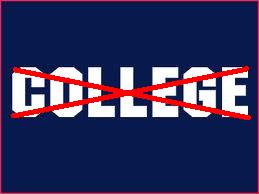
College Not For All

       I'm going to start by saying that I went to college, my wife went to college, my siblings went to college, I want my children to go to college, and everyone I work with went to college.  I'm a big fan of "going to college".  College provides specialized knowledge in a specific field of study; often by people who are experts in that field.  There is a benefit to going to college, but since this post is about "not going to college", I'll just say that the benefits of college are well documented.


       So why am I (a lifelong educator) writing about not going to college?  Because public school desire to teach ALL students.  All students are welcome in our public schools.  We take all students.  We don't have some sort of litmus test that permits some students to enter our public schools and denies others t enter; we take everyone.  And in doing so, we have an obligation to teach all students.  This means that we teach the students who are college-bound as well as those that are not.  This leads to the dilemma of all public schools: Are we preparing students for college?  Are we preparing them for the world of work?  Or, Are we doing both?  (And if the answer is the latter, then How do we do that?)

       We know that all students won't go to college.  (source)  We also know that some will go to college and won't finish college. (source)  Here is a slideshow of 25 jobs that don't require a college degree--although nearly all (or actually all) of these jobs require some sort of education and/or training beyond high school.  So the question remains, How do prepare the college-bound students and the non-college-bound students at the same time?

       The simple answer is that this is a complex problem.  It is a problem that (in my opinion) requires multiple options and pathways for high school students.  It is a problem that does not lend itself to one-size-fits-all solutions.

       It is fair to say that all public schools recognize this need to prepare students for their lives beyond high school--whatever they may be.  But it is also fair to say that some requirements are aimed (more) at the college-bound students than at the non-college-bound students.

       My solution views these two subgroups of students as much more alike then different in terms of the skills and knowledge that they need for both college and work.  Clearly, reading and basic mathematics understanding is needed.  By "reading", I include understanding the context of what is being read; and I include reading and understanding non-fiction and technical manuals.  Our civilized world requires reading.  Medical reports, insurance papers, legal documents such as wills and mortgages all require a level of reading in which people can read and understand.  By "basic mathematics", I include understanding and calculating things such as sales tax and interest income.  People should be able to gain information from a chart, graph, or table of numbers.  People need to know what a percent means and what fractions mean.  Calculators can do the calculations, but people need to do the "understanding".  Beyond reading and mathematics, I believe that a good understanding of other typical high school subjects is needed to help people gain an understanding of the world and the people around them.  These include science, history, art, some computer skills, health, and knowing a foreign language--which is extremely common outside of the United States.

       Beyond these academics, I believe that the rules and regulations that take place in a high school and in the classroom should instill in our students a sense of right and wrong as well as a sense of how to exist as an adult in society.  When my daughter was in kindergarten, her teacher told us that everything they do has a purpose.  What may look like "fun" or "downtime" to the non-kindergarten-teacher observer, has a purpose.  Similarly, everything in high school should have a purpose.  Whether you are going to college or work, you need to be on time, you need to be polite, you need to listen.  You need to learn from others and you need to be able to work with others.  You need to know that sometimes you'll get some help to do things and sometimes you have to do things on your own.  You need to be responsible and you need to take on responsibilities.

       It seems to me that when employers complain about young people in the workplace, it isn't so much that they lack reading and mathematics skills--although I hear this as well.  It is more that they lack the ability to accept responsibilities, to understand written and verbal directions, and to follow through on important tasks.  These skills are needed for the college students also.

       College isn't for everyone.  But public schools and their graduation requirements and daily rules and regulations are for everyone.  Learning is a lifelong skill.  It doesn't stop on graduation day.  We want all students to succeed regardless of the path they take after college.


Friday, 16 December 2016

Do Our Brightest Students Get What They Need?

       Public schools are good at educating the average student.  We are good in the education of above average students.  We spend a lot of time, money, and energy on the education of below average students; and while this is a difficult population in terms of bringing them up to grade-level standards, we've made numerous improvements over the years to help these students.

       This leaves the most limited students and the very brightest students.  For the purposes of this post, I'm defining the very limited as the academically weakest two to three percent of our student population and the very brightest as our top 1% in terms of academic ability.  We have laws and programs and policies to help the most limited of our students.  They may not receive a high school diploma, but we help them to learn as much as possible during their school years so that they can have a full, happy, and satisfying life.  We help them to go as far as they can in terms of skills and abilities.  But when it comes to our very brightest students, I'm not sure that we can say the same.


        Once again, I'm not talking about the typical advanced students in our public schools.  We have programs and/or courses for them that are different from the typical "on-grade-level" programs.  And we do a good job with these typical above-average students.  I'm talking about our most advanced students.  These are the students who don't just stand out in their class, they stand out in their school.  They represent the 1 out of 100 (or more) that excel far beyond the typical advanced students.

       I am a mathematics supervisor.  Mathematics is the one subject that often gets the most attention when the topic of our very brightest students arises.  Parents and policy-makers alike strive to identify these students and endeavor to find a way that best meets their needs.  However all too often our attempts to do this lead to an inadequate solution known as "Acceleration".  Acceleration (in this arena) usually means that these very bright students get the same mathematics content and the same mathematics instruction as everyone else; they just get it at an earlier age and/or they just go through this same content at a faster pace than other students.

       The problem with this solution is that it does not recognize the true abilities of these students, and it does not encourage these students to think harder or reason more.  It doesn't challenge these students to grow and to further develop their strong academic skills.  Instead, this solution only pushes these students to go faster.  Sadly, this solution is often praised by parents and policymakers because our society views "faster" as "better".  We see everything as a competition and those that go faster and jump higher and earn more credits and produce higher grade-point-averages are viewed as the "winners".

       The real danger of inappropriate acceleration for our brightest students is that we place this "speed" over our prime objective of education; which is to actually learn.  Students lose the chance to develop a deep understanding of the content that they master.  They lose the chance to do what they are most able to do which is to question conclusions, discover new solutions, and to create and develop new ideas.  Strategic acceleration could accomplish these goals if the instruction is appropriately geared toward the needs of our brightest students.


       In practice, our public schools struggle with the top 1% because there are so few of them.   We don't have enough of them to make a "class"; sometimes there may not even be one in every grade.  They are spread out throughout a school district.  So we have to figure out a way to provide instruction that meets their needs while still attending to all of our other students.  This is a challenge--and (perhaps) is part of the reason that mere acceleration is so often employed as the "solution".  We also struggle to understand the best way to help teachers to provide this ideal instruction for these students.  So much of public education is geared toward helping our average and weak students; and less attention is geared toward our brightest students.

       The National Association of Gifted Children is a respected organization that addresses the needs of our brightest students and provides resources to help school districts to tackle this problem of providing for these students.  We need to do more and we need to do it in a smarter and more responsible way.


Follow us

@Way2themes

Follow Me