Showing posts with label high school graduation. Show all posts

Thursday, 9 February 2017

High School Should Not be a GPA Competition


       You may need good grades to get accepted to college.  But what you really need is good learning (and a good ability to learn) to graduate from college.  Lots of people go to college, but not a lot of people graduate from college.  A study completed in 2015 found that only 52.9% of students who began college in 2009 had earned a college degree by 2015.  This means that even if we allow students an additional two years to complete a 4-year degree, we are still have only barely half of the students graduating from college.  (Imagine the outcry if the high school graduation rate was 50%!)

       Another study has found that one reason for this dismal college graduation rate is a lack of preparation in secondary schools.  As a educator with 30 years of secondary school experience, I would suggest that it isn't so much that we don't prepare students well, but instead (perhaps) we struggle in our communication with students (and with their parents) when we talk about their actual academic ability.
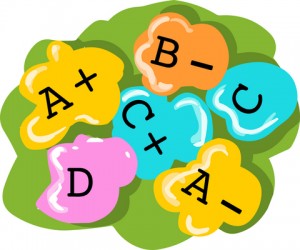
       First of all, our grading system probably doesn't tell the whole story.  Grades are often the primary communication tool that a school has with its students (and their parents) about how well they are doing.  High grades imply high ability and low grades imply low ability.  But is this always true?  And what to medium grades imply?  We don't have a uniform method for determining grades from school district to school district, so does a "B" mean the same thing in every high school in America?

       Secondly, we have high school graduation requirements that are developed in each state in the United States.  Different states have different requirements; although there may be similarities.  But the bigger issue (to me) is:  Is "Graduating from high school" the same as "Being prepared for college"?  Should we have one set of criteria that says "This is sufficient for high school graduation." and another set of (higher level) criteria that says "This is sufficient for good preparation for college."  I think a lot of people feel that if they graduate from high school, then they are prepared for college-level work.  But this isn't always true.

       Hence, high school should not be a place where we only care about getting good grades and getting a high Grade Point Average (GPA).  That might be good enough to get you recognized in high school; and good enough to get accepted to college.  But students who only know how to get good grades without an accompanying ability to learn, will struggle in college.

       Everything in life isn't a competition.  Your education is one of these things.  It doesn't matter if you come in first place.  What matters is that you learn well.

Friday, 3 February 2017

Learning and Thinking - (getting the right answer isn't good enough anymore)


       Learning and thinking have always been closely linked.  But sometimes, in our schools, we only achieve the appearance of learning--often accompanied by very little thinking.  This problem has been recognized by educators for a long time.  In recent years, however, we have been addressing this issue on various fronts.

       Let me begin by explaining what I mean by the term Appearance of Learning.  This is when students get good grades, but their actual learning is very low.  The grade to the students and to their parents makes it appear as if they have learned a lot, but the attainment of those grades may have been based partly on non-academic measures such as good behavior or mere compliance with rules such as turning in homework on time.  This is a problem because when students move on to more complicated coursework that requires previous knowledge, they struggle due to never actually learning the earlier content in the first place.

     Over the past few years, there has been a stronger attempt to balance the need for teaching skills (such as solving an equation) with the need for teaching conceptual understanding (such as using an equation to solve a problem).  This sort of "teaching" is different from when our students' parents were in school--a time in which just-getting-the-answer might have seemed good enough.  Today we know that this isn't good enough.  Students going to college and students going to work need skills and knowledge beyond merely doing what they are told to do.  Today's world demands more from our citizens.


       Our schools recognize this need and we are trying to make changes to address this challenge.  It's hard to change a system of 100,000 schools, 50,000,000 students, and 3,000,000 teachers.  But (indeed) this change is already happening.  What we used to call a "computer room" is now just about any classroom in the building.  Classrooms with students sitting in nice, neat, straight rows that discouraged collaboration among students have been replaced with classrooms with tables or desks arranged in groups to encourage students to work together and ask questions of each other and learn together.  Grades for non-academic behaviors (mentioned above) are strongly discouraged so that a student's grade can more accurately reflect his/her ability in the content.  Finally, student engagement strategies and growth mindset strategies are constantly being discussed and implemented.  These reflect our knowledge of the best way that students learn.  No longer do we expect everyone to learn strictly by listening to the teacher and taking notes.

       Indeed, the change to an educational system that requires more from our high school graduates is well underway.  The past is in the past and we're not going back.  Those that choose not to change risk creating a generation that is ill prepared for the challenges that they will face.  Learning, thinking, reasoning, and problem solving will be more and more integrated into our schools.

       You're welcome.


Follow us

@Way2themes

Follow Me